Yin and Yang: The Ultimate Guide to Balance, Duality, and Personal Harmony | Journal Prompts Included
Introduction: The Dance of Shadows and Light
Look around you. Day gives way to night. The fierce heat of summer slowly cools into the crisp air of autumn. A period of intense activity is followed by a necessary, deep rest. Our world is not a collection of static, separate things, but a dynamic, flowing dance of complementary forces. At the heart of this eternal rhythm lies one of the most elegant and profound concepts ever conceived by humanity: the principle of Yin and Yang.
Originating in ancient Chinese philosophy, Yin and Yang is more than just a trendy symbol on jewelry or yoga mats. It is a foundational framework for understanding the universe, a lens through which we can perceive the interconnected nature of all existence. It teaches us that opposites are not in conflict but in a vital, creative relationship. Light defines shadow, and silence gives music its shape.
This guide is not just an explanation; it’s an invitation. An invitation to see the world differently, to understand the hidden balance in chaos, and to apply this ancient wisdom to find greater harmony in your own life. We will journey through its history, decode its symbolism, explore its applications in health and wellness, and, most importantly, provide you with a series of powerful journal prompts to help you internalize these principles and bring balance into your daily existence.
Part 1: The Historical Roots and Philosophical Foundations
The concepts of Yin and Yang first appeared in the Chinese philosophical text, the I Ching, or Book of Changes (circa 1000-750 BCE), as a way to describe the dualities and cyclical patterns observed in nature. However, it was with the emergence of Taoism that the philosophy was fully developed and systematized.
Taoism and the Way of Nature
Taoism, rooted in texts like the Tao Te Ching (attributed to Lao Tzu) and the writings of Zhuangzi, posits that the universe operates according to a fundamental, indescribable principle called the Tao, or “The Way.” The Tao is the source of everything, the unnameable flow of existence. From this primordial oneness emerge the two fundamental energies: Yin and Yang.
They are the first differentiation from the Tao, the two hands that shape the ten thousand things (a Taoist term for all manifest phenomena). This philosophy is deeply naturalistic. It doesn’t command from on high but observes and aligns with the natural order. Just as a river flows around rocks, the wise person learns to flow with the shifting currents of Yin and Yang in their life.
Core Principles of the Duality
To move beyond a superficial “good vs. evil” interpretation, it’s crucial to understand the core principles that define the relationship between Yin and Yang:
- Yin and Yang are Opposites and Relative: They define each other. What is “Yin” can only be understood in relation to what is “Yang.” For example, a room is dark (Yin) compared to the bright outdoors (Yang), but it becomes bright (Yang) if you light a candle in a pitch-black cellar (Yin). They are not absolute labels but relational concepts.
- Yin and Yang are Interdependent: They cannot exist without each other. There is no concept of “up” without “down,” no “light” without “darkness.” Similarly, there is no activity without rest, no speaking without silence. Each gives meaning and context to the other.
- Yin and Yang Mutually Consume and Transform Each Other: This is the dynamic, living heart of the concept. Yin and Yang are in constant, flowing transition. Day gradually transforms into night, which then transforms back into day. Joy can contain the seed of sorrow, and a period of difficulty (Yin) can transform into strength and growth (Yang). This is represented by the small dot of each within the other in the symbol.
- Yin and Yang can be Subdivided Infinitely: Any Yin or Yang aspect can itself be divided into smaller Yin and Yang components. A house (Yin as shelter, contained) has an active, social living room (Yang) and a quiet, restful bedroom (Yin). Your body has an active, warm core (Yang) and cooler extremities (Yin).
Part 2: Decoding the Symbol and Its Core Meanings
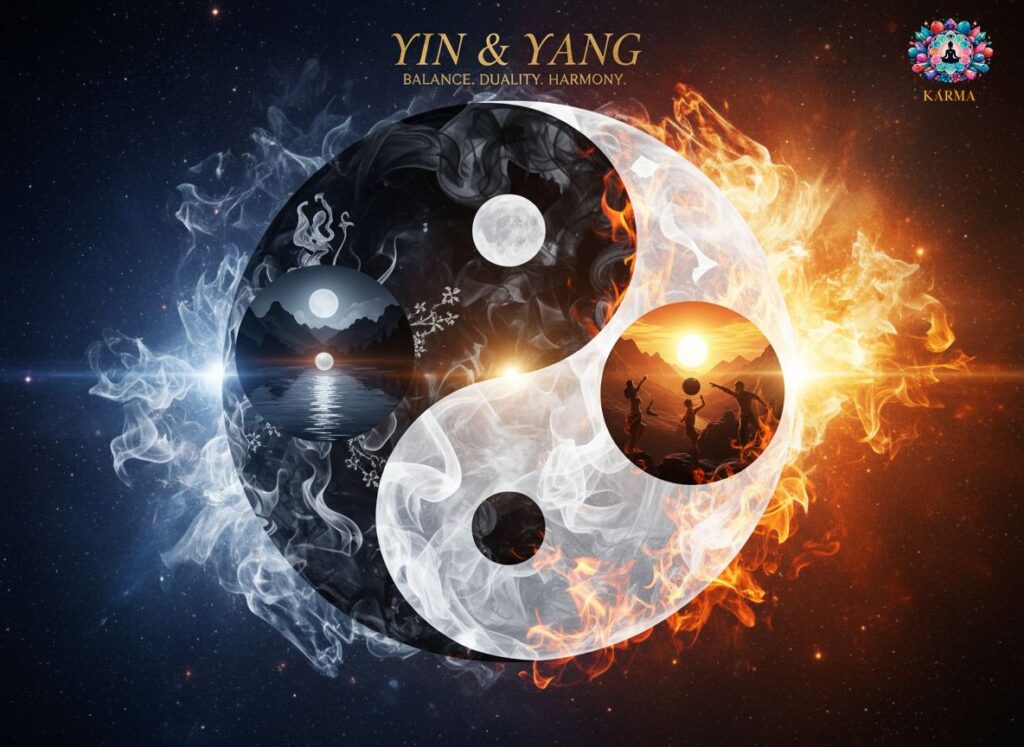
The Taijitu (太極圖), commonly known as the Yin Yang symbol, is a masterpiece of symbolic design, perfectly encapsulating the philosophy it represents.
- The Circle: The whole represents the Tao, the undivided unity from which all things emanate. It signifies the oneness of the universe.
- The Black and White Shapes: The flowing, tear-drop shapes represent Yin (black) and Yang (white). Their equal area shows that both forces are fundamental and balanced in the grand scheme.
- The Curved Line: The “S”-shaped line dividing them is not sharp or straight. It signifies the gradual, continuous, and dynamic flow between the two states. Change is never abrupt; it is a smooth, natural process.
- The Small Dots: Perhaps the most profound element. The white dot in the black field and the black dot in the white field symbolize the seed of one within the other. This reminds us that in the darkest moment, there is the potential for light (hope), and at the peak of success (Yang), the seed of decline (Yin) may already be present. Nothing is purely one thing.
A Detailed Breakdown of Yin and Yang Qualities
| Category | Yin (The Receptive) | Yang (The Creative) |
|---|---|---|
| General | Passive, receptive, internal, conserving | Active, creative, external, expanding |
| Energy | Contracting, inward, storing | Expanding, outward, expressing |
| Nature | Moon, earth, water, valley, tiger | Sun, sky, fire, mountain, dragon |
| Time | Night, autumn, winter, waning moon | Day, spring, summer, full moon |
| Gender | Feminine (not female) | Masculine (not male) |
| Body | Cool, moist, solid, interior, front | Warm, dry, hollow, exterior, back |
| Mind | Intuitive, introspective, quiet, dreaming | Logical, analytical, expressive, focused |
| Action | Rest, sleep, meditation, yielding | Movement, work, exercise, asserting |
It is vital to reiterate that Yin is not “bad” and Yang is not “good.” A world of only Yang (constant sun, endless activity) would be a desert, a burnout. A world of only Yin (eternal night, total passivity) would be a frozen, lifeless void. Life exists in the dynamic, creative tension between the two.
Part 3: Yin and Yang in Action: Applications in Modern Life
This ancient philosophy is not an abstract relic. It is a practical tool for diagnosing imbalance and cultivating well-being in the 21st century.
In Traditional Chinese Medicine (TCM)
Health in TCM is defined as a state of balanced and flowing Qi (vital energy) between Yin and Yang. Illness is a state of imbalance.
- Yin Deficiency: Manifests as symptoms of “heat” and dryness—night sweats, hot flashes, insomnia, dry mouth, anxiety. The cooling, moistening aspect of the body is depleted.
- Yang Deficiency: Manifests as symptoms of “cold” and stagnation—fatigue, feeling cold, low libido, poor digestion, water retention. The warming, activating energy is insufficient.
Treatment through acupuncture, herbal medicine, and dietary therapy aims to tonify what is deficient and reduce what is in excess, restoring the harmonious balance.

In Diet and Nutrition
Foods are classified by their energetic properties, not just their nutritional content.
- Yin Foods: Are cooling, hydrating, and expanding. Examples: most fruits, leafy greens, cucumbers, tofu, seaweed. They cool the body and calm the spirit.
- Yang Foods: Are warming, drying, and contracting. Examples: ginger, garlic, meat, eggs, leeks, spices. They warm the body and increase energy.
- A Balanced Diet: Eating for balance means consuming foods that counteract the season or your personal constitution. In summer (Yang), eat more cooling Yin foods like watermelon and cucumber. In winter (Yin), eat more warming Yang foods like soups and stews.
In Personality and Psychology
We all have a natural inclination towards Yin or Yang energies, and this can shift throughout our lives and even throughout a single day.
- A Yang-Dominant Personality: Might be highly ambitious, competitive, outgoing, logical, and prone to action. The risk is burnout, irritability, and an inability to relax (deficient Yin).
- A Yin-Dominant Personality: Might be highly intuitive, creative, introverted, empathetic, and calm. The risk is lethargy, lack of motivation, indecisiveness, and feeling stuck (deficient Yang).
Psychological health involves recognizing your natural tendency and consciously cultivating the opposite energy to create wholeness. The driven executive (Yang) needs to schedule quiet, unstructured time (Yin). The contemplative artist (Yin) may need to set deadlines and take action to share their work (Yang).
In Relationships and Society
Healthy relationships are a dance of Yin and Yang. Sometimes one person leads (Yang) while the other follows (Yin), and these roles fluidly switch. A relationship where both partners are constantly Yang can be combative; one where both are constantly Yin may lack direction.
On a societal level, we can see imbalances. A culture that glorifies constant productivity, growth, and noise (extreme Yang) leads to widespread stress and environmental degradation. The remedy is not to swing entirely to Yin (passivity) but to reintroduce Yin values—slowness, sustainability, community, and introspection—to restore balance.
Part 4: The Journal Adoptive Prompts for Inner Balance
Understanding Yin and Yang intellectually is one thing; feeling it and living it is another. Journaling is a powerful Yin activity (introspective, receptive) that can help you process the Yang events of your life. The following prompts are designed to be “adoptive”—meaning you can return to them again and again, finding new insights as your life circumstances change.
Adopt this practice: Don’t feel you need to answer all prompts at once. Choose one that resonates with you in the moment. Write freely for 10-20 minutes without self-judgment.
Section 1: Awareness & Observation
- Prompt 1: The Landscape of Your Day. Review your last 24 hours. Map your activities and states of being onto a Yin-Yang spectrum. Which energies dominated? Did you have a balance of activity (Yang) and rest (Yin)? Social time (Yang) and solitude (Yin)?
- Prompt 2: Your Personal Energy Blueprint. Reflect on your natural disposition. Do you lean more towards Yin (calm, reflective, reserved) or Yang (energetic, outgoing, assertive)? How has this inclination served you? Where has it created challenges?
- Prompt 3: The Seeds Within. Recall a recent challenge or “dark” period (Yin). What was the small “dot” of Yang—the opportunity, lesson, or strength—that emerged from it? Conversely, recall a recent success or peak (Yang). What was the small “dot” of Yin—a vulnerability, a new responsibility, or a hint of anxiety—that was present within it?
Section 2: Cultivating Balance & Harmony
- Prompt 4: Nourishing Your Depleted Side. Identify an area where you feel imbalanced. If you are feeling burned out and overstimulated (Yang excess/Yin deficiency), what are three specific, gentle (Yin) activities you can incorporate this week (e.g., a tech-free bath, quiet reading, a walk in nature)? If you are feeling sluggish and stagnant (Yin excess/Yang deficiency), what are three small, energizing (Yang) actions you can take (e.g., a 10-minute workout, tackling a small procrastinated task, initiating a social call)?
- Prompt 5: The Wisdom of the Seasons. Observe the current season. Is it Yin (autumn/winter) or Yang (spring/summer)? How is your life in harmony or discord with this natural cycle? Are you trying to be hyper-productive in the resting season of winter? How can you align your rhythm, diet, and activities to better flow with the season?
- Prompt 6: The Balance of Giving and Receiving. Relationships are an exchange of energy. In your key relationships (partner, family, friends, work), do you tend to be more in the giving (Yang) or receiving (Yin) role? Is this balance healthy? If not, what is one small step you can take to restore equilibrium?
Section 3: Deep Integration & Transformation
- Prompt 7: Embracing Your Inner Opposite. Personify your dominant energy. If you are naturally Yin, give a name to your “Inner Warrior” (Yang). If you are naturally Yang, give a name to your “Inner Sage” (Yin). Write a letter from this inner figure to you. What wisdom, advice, or warning do they have for you about finding greater wholeness?
- Prompt 8: The Flowing “S” Curve. Think of a major transition you are going through—a career change, the end of a relationship, a move, a new project. Using the curved line of the symbol as a guide, how can you navigate this change more gracefully and gradually, rather than forcing an abrupt shift? What small, smooth steps can you take?
- Prompt 9: Conflict as Complementary. Describe a recent conflict or disagreement you had. Instead of seeing the other person as “wrong,” can you reframe their position as the complementary opposite (Yin to your Yang, or vice versa)? What is the larger truth that might be holding both of your perspectives? What synthesis is possible?
- Prompt 10: Your Personal Taijitu. Imagine designing a personal Yin-Yang symbol that represents your life right now. What two forces are in play (e.g., Work and Rest, Logic and Intuition, Stability and Adventure)? How are they flowing into one another? Where are the seeds of one within the other? Draw or describe this symbol and its meaning.
Conclusion: Living the Dynamic Balance
The journey of understanding Yin and Yang is a lifelong practice. It is not about achieving a perfect, static 50/50 split, but about learning to ride the waves of change with awareness and grace. It’s about recognizing that in the midst of chaos, there is a center of calm (Yin in Yang), and in deep stillness, there is the potential for powerful action (Yang in Yin).
This symbol is a mirror reflecting the universe’s most fundamental truth: that all things are connected, relational, and in a beautiful, eternal state of becoming. By adopting this perspective, we can release our grip on rigid either/or thinking and embrace a more fluid, compassionate, and holistic way of being.
We can learn to honor our need for both action and rest, for both community and solitude, for both striving and surrendering. We can see our challenges not as punishments but as necessary phases in our growth, containing the very seeds of our future strength.
So, the next time you see the Yin Yang symbol, let it be a reminder. A reminder to pause and check your inner weather. A reminder to embrace the full spectrum of your experience. A reminder that you are not a fixed entity, but a living, breathing, dynamic expression of the great, flowing Tao—a perfect, ever-changing balance of shadows and light.