Yin and Yang: Understanding the Fundamental Duality of the Universe
In a world that often feels fragmented and chaotic, the ancient search for underlying order and harmony is more relevant than ever. One of the most elegant and enduring frameworks for understanding the dynamics of the universe comes from Taoist philosophy: the concept of Yin and Yang. More than just a popular symbol on jewelry and posters, Yin and Yang represents a profound and sophisticated system for perceiving the fundamental duality and interconnectedness of all things.
This principle teaches us that opposites are not in conflict but in a perpetual, creative dance. By understanding Yin and Yang, we can learn to navigate the complexities of our lives, relationships, and inner worlds with greater wisdom, grace, and balance.
The Symbol and Its Deep Meaning
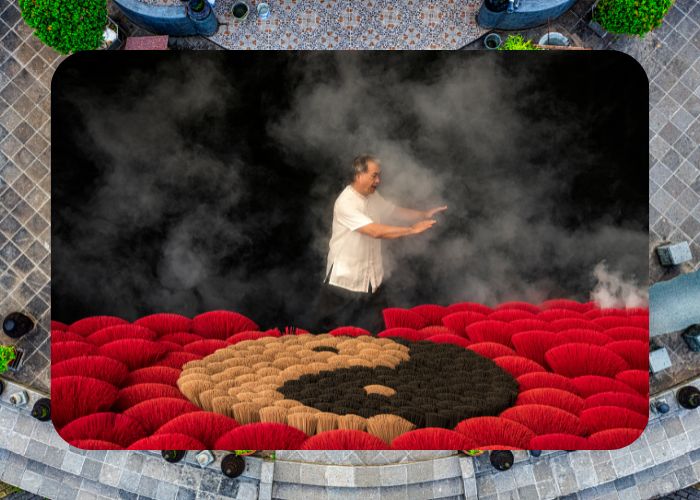
The Taijitu symbol, commonly known as the Yin-Yang, is instantly recognizable. Its simple, flowing design holds a universe of meaning:
- The Circle: The encompassing circle represents the whole, the undivided universe, or Wuji (無極)—the state of primordial emptiness and potential before duality arose.
- The S-Shaped Line: The flowing, S-shaped curve that divides the circle signifies that life is not static but in constant, dynamic motion. It shows that the transition between opposites is gradual and seamless.
- Black and White Teardrops: The black (Yin) and white (Yang) sections are not static blocks but flowing forms, each containing a seed of its opposite. This is the most crucial aspect—within Yin, there is always the potential for Yang, and within Yang, the seed of Yin exists.
- Equal Proportions: The symbol is perfectly balanced, illustrating that both forces are equally necessary for a harmonious whole.
Defining the Forces: The Qualities of Yin and Yang
Yin and Yang are not “good” or “bad.” They are relative, descriptive qualities. One cannot exist without the other; they define each other.
Yin (The Black Side)
Yin is the receptive, internal, and feminine energy. It is associated with the moon, darkness, cold, rest, intuition, and the earth. Think of the quiet of night, the softness of a valley, the nourishing depth of the soil, or the introspective nature of thought.
Qualities: Passive, cool, dark, inward, soft, slow, moist, substantial.
Yang (The White Side)
Yang is the active, external, and masculine energy. It is associated with the sun, light, heat, movement, logic, and the sky. Consider the brilliance of daylight, the peak of a mountain, the explosive energy of fire, or the outward expression of speech.
Qualities: Active, warm, bright, outward, hard, fast, dry, insubstantial.

The Core Principles of the Yin-Yang Relationship
The true genius of this philosophy lies not in the definitions, but in the dynamic principles that govern their relationship.
- Yin and Yang are Opposites and Relative: Everything in the universe can be understood in relation to its opposite. However, this is always relative. For example, a cup of warm water is Yang compared to ice water (Yin), but it is Yin compared to boiling water (Yang).
- Yin and Yang are Interdependent: They cannot exist alone. There is no concept of “up” without “down,” no “light” without “dark,” and no “activity” without “rest.” Our most productive (Yang) periods are only possible because of adequate sleep and recovery (Yin).
- Yin and Yang Mutually Consume and Transform Each Other: This is the principle of dynamic balance. The proportions of Yin and Yang are always shifting. Day gradually transforms into night, which then transforms back into day. Seasons cycle, and our own energy levels ebb and flow. This constant transformation is the engine of all change.
- Yin and Yang Contain the Seed of the Other: This is the meaning of the small dots in the symbol. Within the peak of success (Yang) lies the potential for failure or a need for rest (Yin). Within the depth of grief or stillness (Yin) lies the seed of new growth and action (Yang). This offers profound hope—no situation is permanent or absolute.
Yin and Yang in Action: Practical Applications for Modern Life
This ancient wisdom is not meant to be locked away in texts; it is a living philosophy with immediate, practical applications.
1. In Health and Wellness:
Traditional Chinese Medicine (TCM) is built upon the Yin-Yang principle. Health is seen as a state of dynamic balance between these forces.
- Yin Deficiency: Might manifest as hot flashes, night sweats, dryness, and anxiety (a lack of cooling, moistening energy).
- Yang Deficiency: Might appear as cold limbs, fatigue, low motivation, and sluggish digestion (a lack of warming, energizing force).
A balanced lifestyle includes both Yang activities (exercise, work) and Yin activities (meditation, sufficient sleep, mindful eating) to maintain this equilibrium.
2. In Personality and Psychology:
We all have a unique blend of Yin and Yang traits. A healthy psyche honors both.
- Yang Traits: Outgoing, assertive, logical, goal-oriented.
- Yin Traits: Introspective, receptive, intuitive, empathetic.
Suppressing one in favor of the other creates internal conflict. An overly Yang person (always “on,” never resting) risks burnout. An overly Yin person (passive, avoiding action) may struggle to manifest their goals. Balance involves giving voice to both your inner leader and your inner listener.
3. In Relationships and Society:
Relationships are a dance of mutual exchange. Sometimes one partner leads (Yang), and the other follows (Yin), and these roles fluidly switch. A healthy relationship is not 50/50 all the time, but a dynamic flow where both individuals feel safe to express both their strong (Yang) and vulnerable (Yin) sides.
On a societal level, we can see the need for balance between action (Yang) and reflection (Yin), competition (Yang) and cooperation (Yin), and progress (Yang) and tradition (Yin).
Journaling Prompts for Self-Reflection and Balance
To truly integrate the wisdom of Yin and Yang, move from passive reading to active reflection. Use these prompts in your journal to explore your own inner landscape.
Section 1: Identifying Your Personal Balance
- Draw a large Yin-Yang symbol. In the Yin (receptive) half, list the activities, traits, and moments in your life that feel nourishing, quiet, and restorative. In the Yang (active) half, list those that feel energizing, productive, and outward-focused. Is your symbol balanced, or is one side significantly larger? What does this reveal?
- Reflect on your energy levels throughout a typical week. When do you feel most Yang? When do you feel most Yin? Are you honoring your natural rhythms, or fighting against them?
Section 2: Cultivating What’s Lacking
- If you feel over-Yanged (burnt out, stressed, restless): How can you consciously invite more Yin into your life? This could be scheduling 15 minutes of silence, taking a bath, reading fiction, or practicing gentle yoga. Write down three specific Yin activities you will incorporate this week.
- If you feel over-Yinned (lethargic, stagnant, unmotivated): How can you gently invite more Yang energy? This might be a brisk walk, tackling a small project you’ve been avoiding, socializing with a friend, or setting a clear intention for the day. List three small, actionable Yang steps.
Section 3: Seeing the Seeds of Change
- Think of a current challenge or “negative” situation (a seed of Yin). Can you find the tiny dot of Yang within it—the potential for growth, learning, or a new direction? Describe it.
- Now, consider a current success or a “positive” situation (a seed of Yang). Where is the dot of Yin? Is there a hidden cost, a need for gratitude, or a reminder to stay grounded? Explore this duality.
Section 4: Relationships as a Dance
- Choose one important relationship in your life. Map out the roles you and the other person typically play. Who is more often Yang (initiating, deciding)? Who is more often Yin (listening, supporting)? Is this dynamic flexible? How could you consciously shift the dynamic to create more balance and mutual understanding?
Conclusion: Embracing the Dynamic Dance
The teaching of Yin and Yang is ultimately a call to release rigid, either-or thinking and embrace the fluid, both-and nature of reality. It is a philosophy of wholeness that encourages us to honor the darkness as much as the light, the silence as much as the sound, and the rest as much as the activity.
By observing these principles in the world around us and within our own beings, we can stop fighting the natural cycles of life and learn to move with them. We discover that balance is not a final destination to be reached, but a continuous, graceful, and dynamic dance—a dance where every step, whether Yin or Yang, is an essential part of the beautiful, unfolding whole.